From Regulation to Revolution: How Grief, Connection, and the Nervous System Can Change How We Support Children
November 5, 2026 | 12:00pm to 2:30pm ET | A free education event honoring Children’s Grief Awareness Month
What if creating a more peaceful world begins by changing how we understand and respond to grief?
Grief is not only an emotional experience. It is neurobiological, relational, embodied, and collective. This experiential keynote-style webinar explores how working with grief can create change from the micro to the macro level: within our bodies, with children, clients and patients, across families, schools, organizations, communities, and ultimately the world around us. At the heart of the presentation is a powerful premise: underneath violence can be hate, underneath hate can be anger, underneath anger can be fear, and underneath fear, we often find grief. This does not mean grief causes violence. Rather, it invites us to become curious about what lies beneath behaviors and divisions and how addressing grief, fear, and dysregulation can support prevention, healing, and peacebuilding.
Children are essential to this conversation. They often communicate grief, fear, and overwhelm through their bodies and behavior long before they have words to explain what they are experiencing. What if, instead of only responding after children become overwhelmed, we taught them to recognize their nervous system states and gave them tools to work with anger, fear, grief, and activation? These are skills they can carry throughout their lives. Attachment and co-regulation are central because children first learn regulation through relationships with responsive adults.
Who should attend? The event is for mental health professionals, educators, grief counselors, social workers, bereavement support staff, community members, funeral professionals, and volunteers – anyone who works with or supports children and families who are bereaved.
Objectives:
- Describe how grief impacts the autonomic nervous system, attachment systems, and window of peace in children, including neurodivergent presentations of regulation and dysregulation.
- Demonstrate strategies for fostering co-regulation, relational safety, and sensory-informed support to enhance resilience in grieving children across diverse developmental and neurodivergent needs.
- Apply developmentally appropriate and neurodivergent-affirming somatic frameworks (vagus nerve regulation, bilateral movement, and contraction/expansion pendulation) to support children’s grief expression and integration.
Our Presenters:
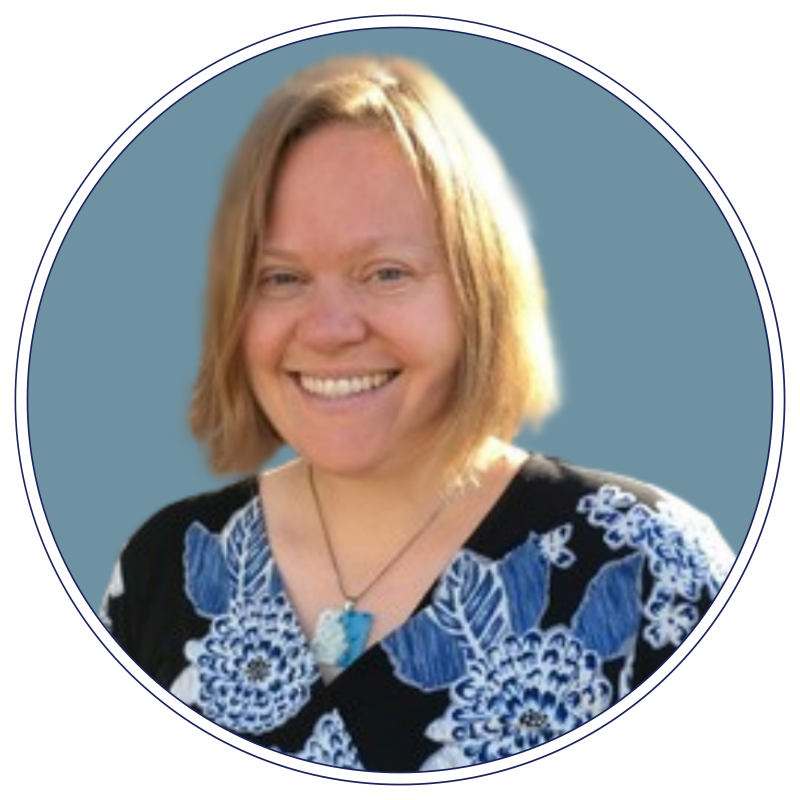
Amy Pickett-Williams, LCSW, RYT-200, is a licensed clinical social worker, yoga teacher, author, and national speaker with more than 25 years of experience supporting individuals and families through grief, trauma, illness, child loss, caregiving, burnout, and significant life transitions. Her work bridges psychotherapy, neuroscience, contemporary grief theory, and somatic practice, with a particular focus on understanding grief as an emotional, physiological, relational, and embodied experience.
Amy teaches professionals and communities to approach grief through a polyvagal-informed, non-pathologizing lens, emphasizing practical ways to support nervous-system regulation, resilience, connection, and our capacity to grow around grief. She is the author of the forthcoming Embodying Grief: Somatic and Polyvagal-Informed Practices for Finding Peace After Loss, published by New Harbinger.

Dr. Katie Mattei, PsyD, is a clinical psychologist, author, and national speaker with more than 30 years of experience specializing in grief, trauma, child loss, burn injuries, and professional burnout. She is on faculty at Children’s Hospital Colorado and has extensive experience working with children and families, healthcare professionals, first responders, trauma survivors, and professionals exposed to cumulative grief and trauma.
A graduate of Columbia University and the University of Denver, Katie integrates psychological science, trauma-informed care, and somatic approaches to help people understand how grief and trauma affect the brain, body, nervous system, relationships, and capacity for connection. She consults with schools and organizations and is the author of An Ocean of Grief: Surviving the Loss of a Child, drawing from both professional expertise and lived experience to illuminate the complexities of child loss and healing.
Together, Amy and Katie bring more than five decades of clinical experience to their teaching on grief, trauma, somatic healing, and resilience. Their work moves from the micro to the macro—from what happens within an individual nervous system, to relationships and families, to schools, workplaces, healthcare systems, communities, and the broader culture. Their approach combines science with compassion and translates complex concepts into accessible practices people can use in their own lives and in supporting others.
LIGHT Movement (Love In Grief, Held Together) is a nonprofit founded by Amy to make somatic, grief-informed support and education accessible to individuals, professionals, and communities. Through retreats, workshops, grief-support programs, professional education, community gatherings, and body-based practices, LIGHT creates spaces where people can understand and experience grief without judgment or pressure to “move on.” Its work is grounded in a simple but powerful vision: peaceful communities where no one grieves alone.
Continuing education credits: Please note that continuing education credits are not available for this event.
To request accessibility accommodations: The National Alliance for Children’s Grief is committed to providing universal access to all our events. Please contact Megan Lopez at megan.lopez@childrengrieve.org or at (432) 288-4688 to request disability accommodations. Advance notice is necessary to arrange for some accessibility needs.